

The Signal
Lead-scoring tools help teams prioritize interest. Each business still needs a defined route for responding to it.
The Growth Stage
Your CRM can show that someone is active. It cannot decide what your team will do with them.

THE AUTHOR
By Luna Clervaux-Morris · Founder, FourStage & Co.
WHAT WE’RE WATCHING
Lead-scoring tools help teams prioritize interest. Each business still needs a defined route for responding to it.
Interest cools while a record waits for a decision, an owner, and a useful response.
Growth systems break where information must become a decision, an owner, and a timely next action.
A prospect has read two articles, downloaded a practical guide, and returned to your website. Your CRM gives the activity a high score. The record appears on a report. Then it waits.
That is a constructed scene, but it points to an operating question: what happens when your system identifies interest? Someone needs enough context to choose a useful response, accept responsibility, and carry it out.
Growth systems break where information must become a decision, an owner, and a timely next action.

Lead scoring helps a team prioritize attention. A 2023 review by Migao Wu, Pavel Andreev, and Morad Benyoucef examined 44 studies of lead-scoring models and their impact on sales performance. Its focus was evaluating and prioritizing leads; the review does not establish a universal score at which every business should contact a buyer.
For your team, the useful question is what each kind of interest warrants. A resource download can warrant delivery of the promised resource. A request to discuss a project warrants an informed human response. The next action should follow what the person has actually asked for.
Consider one fictional professional-services firm throughout this issue. A prospective client reads its delivery guide, then asks how the firm would scope a project for their business. The record should carry that request, its context, and the route into a conversation.
For that firm, the rule is concrete: a project-scoping inquiry goes to the business-development lead with the buyer’s stated problem attached. The handoff begins with that routing decision. Write the equivalent rule for the interest your own business receives.
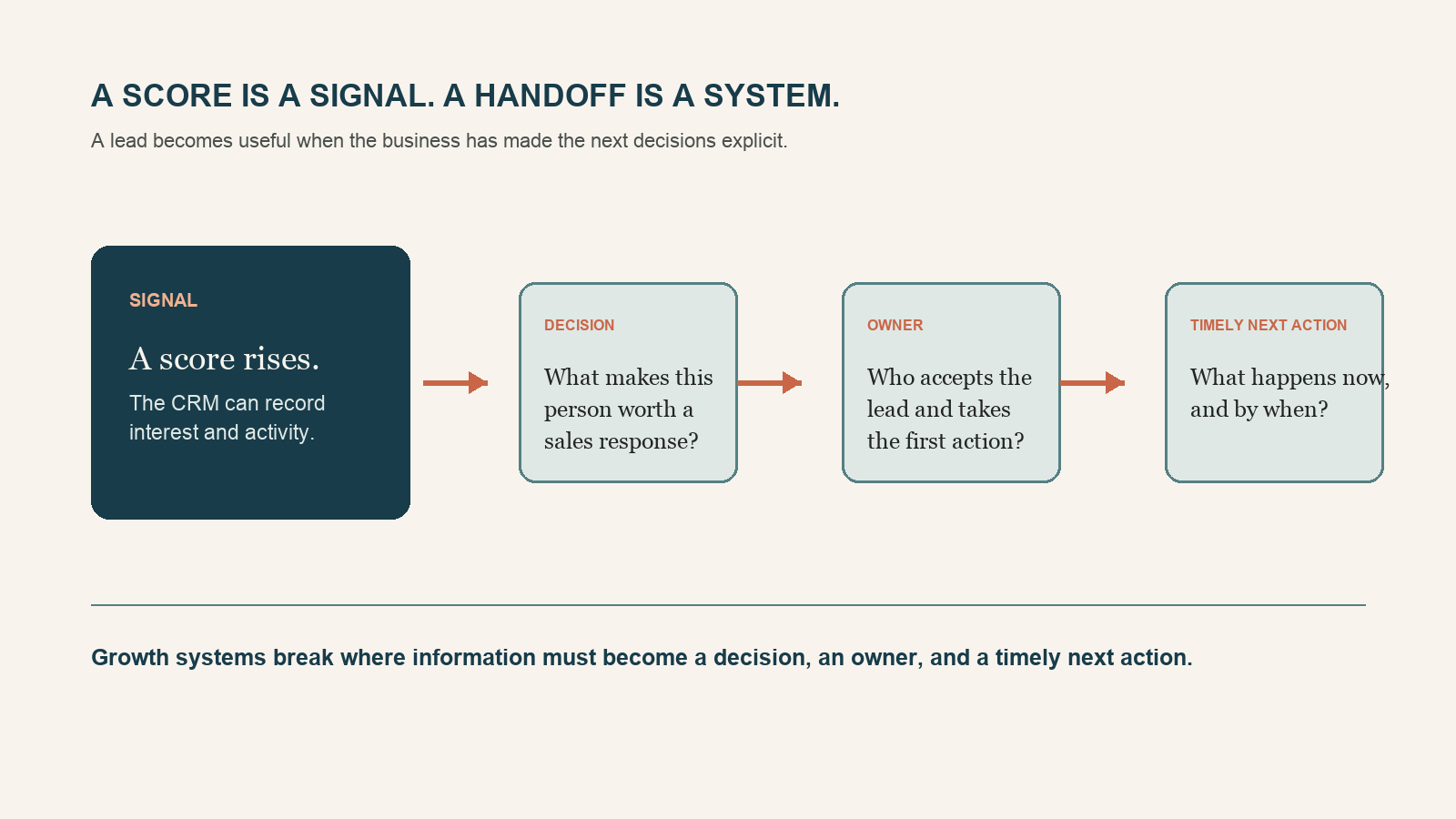

A useful readiness rule identifies the facts needed for the next step. For a scoping conversation, those might be the service requested, the situation the buyer wants to change, and whether the firm can reasonably help. Qualification should make the next conversation easier to prepare.
Research by Gaurav Sabnis and colleagues in the Journal of Marketing examined 461 sales representatives across four firms. Their pursuit of marketing leads varied with prequalification, managerial tracking, lead volume, and sales-representative characteristics. Published in 2013, the study offers evidence about organizational processes, rather than a current response-time benchmark.
In our fictional firm, the prospect writes: “New client projects keep starting late. Can you explain how you would scope the handoff work?” That supplies a recognizable problem and an explicit request. The receiving person can check the firm’s ability to help and prepare a relevant reply. Missing timing or budget information can be clarified in that conversation.
Put the readiness rule in one sentence that the people sending and receiving leads can apply: “A request to discuss a delivery problem we address is ready for a business-development response.” Record the request and the fit decision beside the lead. This gives the receiving person a reason to act.

A handoff needs one named owner, a due time, and a clear purpose for the first response. A notification sent to a group leaves the acceptance decision open. The person receiving the record needs to know that it is theirs to act on.
The fictional firm assigns its business-development lead to respond by the end of the next business day. This is an illustrative service standard, chosen for that firm’s staffing and inquiry type. Each business needs a commitment its team can keep, including cover when the owner is unavailable.
The first reply addresses the buyer’s question: “You mentioned delays when new client work starts. We begin scoping by reviewing how sales passes the agreed work to delivery. Could you share where the start most often stalls? We can then arrange a short conversation about the review.”
Before automating that route, create the handoff record: buyer request, reason for the referral, named owner, response due time, and intended first action. Then test it with one recent inquiry. The person receiving it should be able to act without asking the founder what happens next.

Sending the reply completes one action. Recording what happens next lets the business improve the route. The owner should leave the contact in a defined state with a next action or a reason for closure.
In the same example, a buyer who agrees to talk becomes “Conversation booked,” with the meeting date recorded. A buyer who says the project is for next quarter becomes “Timing deferred,” with an agreed return date. A poor fit is closed with a reason. No reply follows the firm’s agreed follow-up policy, which includes a stopping point.
Those outcomes help a team locate the work that needs attention. Accepted inquiries waiting without a response point to the handoff process. Repeated poor-fit inquiries point to the qualification rule or the content bringing them forward. Conversations that consistently stall around the same unanswered question point to information the business should supply earlier.
Review a small batch of recent handoffs together. For each one, confirm who acted, whether the response was on time, what happened, and what happens next. Fix the earliest recurring gap. The reader’s practical starting point is a single complete route from inquiry to recorded outcome; the firm can repeat and refine it as demand grows.
YOUR MOVE
Choose one inquiry type your business receives regularly. Write its routing rule, qualification facts, named owner, response due time, and outcome choices. Test the route with one recent inquiry and review the result with the people who send and receive the lead.
RESEARCH BEHIND THIS ISSUE
Wu, Andreev, and Benyoucef · Information Technology and Management · 2023
A systematic review of lead-scoring models and their sales-performance implications.
Sabnis, Chatterjee, Grewal, and Lilien · Journal of Marketing · 2013
Research on lead follow-up, prequalification, and organizational processes. The study examined 461 sales representatives across four firms.
Quick-Start Lead Nurture Playbook · Act-On · 2026
A vendor playbook used as the familiar automation model this issue examines.
FOURSTAGE INSIGHTS
YOUR TURN
Share a question about brand, growth, or the structure of your business. A person at FourStage reads every submission. We may explore the question in a future issue.